Everyone’s talking about AI. We think they’re asking the wrong question.
Open LinkedIn for five minutes and you’ll see it. Every other post is about AI and what it means for marketing. Some people think it’s replacing creative work, while others think it’s the best productivity tool we’ve ever had.
We think the more interesting question isn’t what AI can create, but what people will actually pay attention to.
In the age of AI creating content has never been easier, while earning customer trust has never been harder.
As AI makes content faster and cheaper to produce, authentic storytelling becomes even more valuable. In this new stage of marketing the brands that stand out won’t be the ones publishing the most, they’ll be the ones giving people a reason to care.
More Content Doesn’t Mean More Connection
The internet is becoming incredibly oversaturated with AI-generated content. The Traceability Hub projects that nearly 90% of online content could be AI-generated by the end of 2026.
As more and more agencies and marketing teams embrace AI in the name of productivity, research shows that the customers are pulling away. Research from the Nuremberg Institute for Market Decisions found that when consumers know content was generated by AI, they perceive it as less natural, less useful, and are less likely to engage with it or make a purchase. A 2026 literature review published in the American Impact Review reached a similar conclusion, finding that disclosure of AI-generated content often activates consumer skepticism and weakens trust because authenticity becomes the deciding factor.
In the age of oversaturation in the online space, the defining principle for the future of marketing must be quality over quantity.
Coca-Cola Learned This the Hard Way
Coca-Cola’s AI holiday campaigns are a good example of what happens when efficiency becomes the priority.
In 2024, the company recreated its iconic Holidays Are Coming commercial using AI. The reaction was immediate as viewers described it as “soulless” and missing the emotion and human quality that made the original memorable.
The following year, Coca-Cola expanded its AI approach, dramatically reducing production time and generating tens of thousands of AI-created assets. But despite those efficiencies, public sentiment dropped from 23.8% to 10.2% after the campaign launched.
AI Is a Tool. It Was Never the Strategy.
AI is good at processing data, automating repetitive work, and accelerating production, which is why the industry’s biggest players are investing in it. McKinsey research estimates agentic AI could eventually power as much as 60% of tasks across the marketing process, from content generation to media planning.
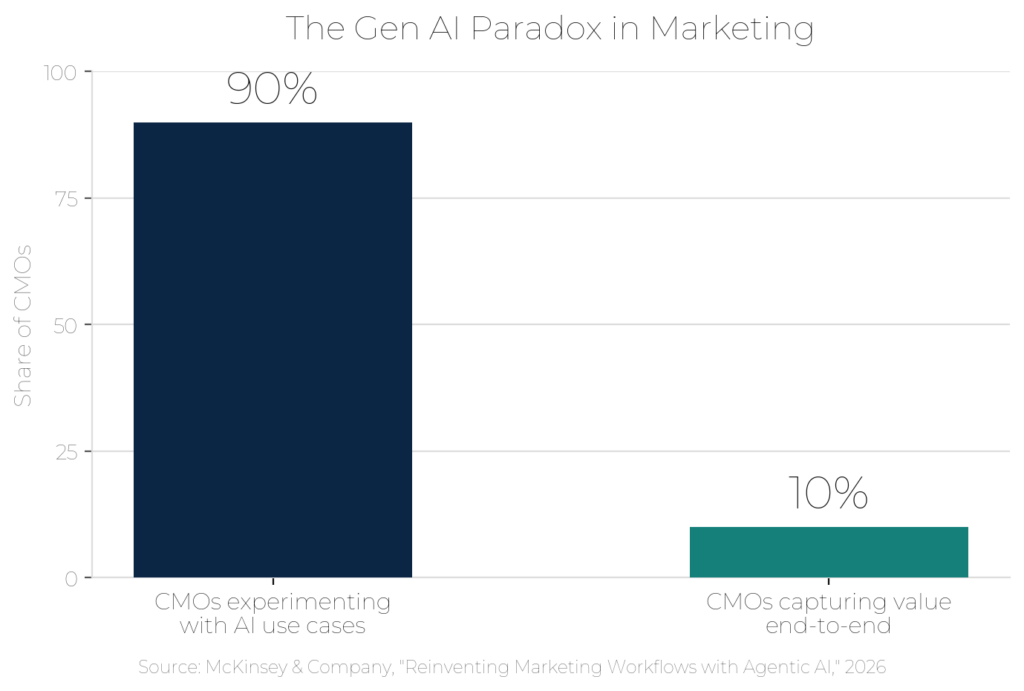
But speed isn’t the same as human judgment and creativity, and the implementation of AI has not necessarily translated to concrete results. McKinsey found that nearly 90% of CMOs are experimenting with AI use cases across their marketing process. Fewer than 10% have captured measurable value from it end to end. Researchers call this gap the “gen AI paradox,” technology that shows up everywhere except the bottom line.
Research published in the Journal of Advertising warns that as more brands rely on the same generative AI models, creative work risks becoming increasingly homogenized. AI can generate ideas, but it can’t understand the context behind a brand, challenge a strategy that misses the mark, or be accountable for the outcome.
The agencies that will thrive won’t be the ones producing the most content, they’ll be the ones clients trust to ask better questions, make smarter decisions, and stand behind the work.
Where AI Actually Fits Into Our Process
We’re not interested in pretending AI doesn’t exist, and we’re not interested in hiding behind it either.
At Oniracom, AI shows up in the parts of our process built for speed, it does not show up in the parts of our process that require judgment and creativity. Strategy, creative direction, production, and the read on whether something actually fits a brand stays with our team every time.
Research shows that this is where the industry is actually heading. McKinsey’s research on agentic marketing found that as AI takes on more of the execution, the human role shifts toward what can’t be automated: developing strategy and content based on taste and instinct, building real relationships with the people a brand is trying to reach, and showing up in person where that still matters. That’s where we want our team spending its time, and it’s why we built our process around protecting it.
That’s the Work We Believe In
For 25 years, we’ve built our work around relationships, not algorithms.
We’ve worked with artists, nonprofits, venues, and brands long enough to know that trust is built through consistency, context, and understanding the people you’re trying to reach, and can not be generated overnight.
That’s the part of agency work that AI can’t replace.
We’ll keep using new technology where it makes us more efficient, but creativity, strategy, and relationships will always stay human.
As AI-generated content becomes the norm, we believe the brands people remember will be the ones that still feel genuine, distinct, and connected with real human emotion.
That’s what we’ve believed for the last 25 years. It’s what we’ll keep believing for the next 25.
If you’re building something meant to last, we’d love to help tell that story.
Works Cited
Boston Consulting Group. “Agentic Scenarios Every Marketer Must Prepare For.” BCG, 2026, www.bcg.com/publications/2026/agentic-scenarios-every-marketer-must-prepare-for.
“Coca-Cola’s AI Holiday Ad Triggers Backlash.” Content Grip, 2026, www.contentgrip.com/coca-cola-ai-holiday-ad-backlash/.
Esber, Dianne, et al. “Reinventing Marketing Workflows with Agentic AI.” McKinsey & Company, 21 Apr. 2026, www.mckinsey.com/capabilities/growth-marketing-and-sales/our-insights/reinventing-marketing-workflows-with-agentic-ai.
“Experts: 90% of Online Content Will Be AI-Generated by 2026.” The Living Library, thelivinglib.org/experts-90-of-online-content-will-be-ai-generated-by-2026/.
“Harmony or Discord? The Intersection of Generative AI and Human Creativity in Advertising.” Journal of Advertising, 2025, doi.org/10.1080/00218499.2025.2464305.
Nuremberg Institute for Market Decisions. “Consumer Attitudes Toward AI-Generated Marketing Content.” NIM, www.nim.org/en/publications/detail/transparency-without-trust.